














Medical assistants want a new name and more power. Not everyone is happy.
If you end up in an urgent care center in America, it is increasingly likely that you will be treated by a PA. For a long time, PA meant the same thing everywhere: “physician assistant,” a licensed medical professional who can provide patient care, including prescribing medications, under the supervision of a physician.
But that could change. In Oregon, New Hampshire and Maine, “PA” now means “physician assistant,” and other states could follow suit this year.
“Assistant” versus “assistant” may sound like a trivial semantic debate, but for many physicians and for the American Academy of Physician Associates (which changed its own name in 2021), it is an important part of the growing role of PAs in healthcare.
“If it’s a ‘physician assistant,’ even the patient thinks, OK, if you’re just assisting, when will the actual provider come?” said Chantell Taylor, public affairs and advocacy director for AAPA
Since 2000, the number of PAs has quadrupled, while many parts of the country face a physician shortage. This means that PAs are becoming more numerous and visible in all areas of medicine, from primary care to dermatology. And with the name change they are also aiming for the possibility of operating more independently of doctors.
Not everyone is happy. The American Medical Association, which represents doctors, called the name change a “branding effort” that would only confuse patients. The AAPA says the AMA is “stoking fear” over bills proposed in several states. It turns out there’s a lot in a name.
“We have a shortage of doctors and trained professionals,” said Rob Kupec, a Democratic senator from Minnesota who is pushing for a name change in his state. “There are people who may not have the same level of education but have the ability to do some of these things.”
While the number of doctors has increased by around 40 percent since 2000, the number of general practitioners has grown much more rapidly.
A growing role
The conflict between assistants and assistants is mainly about their relationship with doctors.
When PAs are hired by a hospital, they enter into not only an employment contract but also a separate “supervision agreement” with a physician. Supervising physicians typically have a duty to review medical records and approve certain prescriptions. More importantly, the care agreement means that the doctor is legally responsible for any harm to the patient.
But with the increase in PAs and long wait times to see a doctor, legislators in many states are loosening these agreements to give PAs more authority to do their jobs.
In 2021, Florida changed its laws to allow physicians to supervise ten PAs instead of four. Pennsylvania has eliminated the requirement that physicians review all charts prepared by PAs. In Arkansas, PAs can now submit applications directly to Medicaid instead of submitting them to their supervising physician.
Many states, including California, have changed the legal term “supervising physician” to “collaborating physician.” This name change is preferred by the AAPA to reflect the changing hierarchy, although the hierarchy still exists. Collaborating physicians are still required to review medical records and are liable for care.
Although over 90 percent of PAs work as employees for a larger medical practice, a small but growing number have opened their own practice. In most states, independent PAs still require a supervising physician, so they must find and pay for one themselves. The number of chart reviews or site visits required varies by state.
“The more work these rules require, the higher the fees doctors tend to charge,” said Christopher Turitzin, who runs a company that matches independent individuals and supervising physicians. He said the average deal signed through his website, Single Aim, is $670 per month. In Minnesota, where there are fewer restrictions, the average is $500 per month, while in Tennessee it is over $900.
But in New Hampshire, which has eliminated the supervising physician requirement, experienced PAs don’t have to pay a doctor at all.
A long debate about names
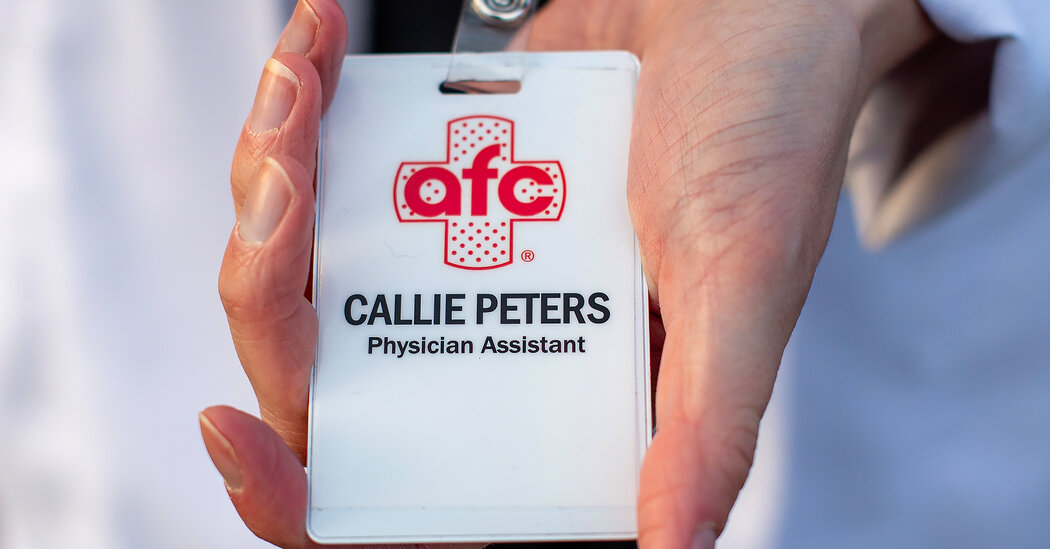
Callie Peters is an assistant at an urgent care clinic in Hillsboro, Oregon. Her company and her co-workers refer to her as “Physician Assistant,” but she still wears an old name tag that says “Physician Assistant.” Either way, many patients don’t know the exact nature of their work.
A study commissioned by the AMA in 2024 found that 22 percent of people thought PAs were “doctors.” The group argued that changing the name to “Physician Associate” would cause more confusion among patients.
However, according to AAPA, the associate title better reflects the actual job.
“There are resources that are being fought over,” said Dr. Caleb Alexander, an epidemiologist at the Johns Hopkins Bloomberg School of Public Health who has studied the practices of doctors and PAs. “Such professional boundaries have been controversial for many years.”
When the first class of PAs graduated in 1965, the title had an apostrophe: physician assistant, intended to reflect the role as “an additional right hand to the physician.” The PA was then expected to perform minor tasks, such as taking the patient’s history and conducting physical examinations.
In the early 1980s, after much debate, the AAPA decided to drop the apostrophe to indicate that PAs were not assistants to physicians (although you may still see apostrophes in news articles and even state laws).
The AAPA also made the switch to “Physician Associate” for a few years in the 1970s before the AMA pushed the organization to change the name again out of fear that patients would “think they were on par with doctors,” said Michelle Schabowski, archivist for the PA History Society.
The AMA has also advocated against name changes in other medical fields. She has opposed legislation that would license a podiatrist as a “pedicurist” or an anesthesiologist as a “nurse anesthesiologist.”
In many areas, research has shown that PAs provide high quality care, although circumstances play a role in the policy debate.
Approximately 25 percent of interns work in surgical residency or as part of a hospital team. Several studies have found similar patient outcomes to those with medical care alone. For the 20 percent of PAs who work in primary care, the data is less clear.
David H. Aizuss, chairman of the AMA Board of Trustees, said physician-directed care, with its more comprehensive training, represents the highest quality of patient care.
Others argue that availability of care is an overlooked aspect of quality of care. Rachael Cabral-Guevara, a Wisconsin state senator, pointed to the shortage of physicians in her state and supported a bill to expand the role of PAs
“It can take days or weeks to schedule appointments,” she said. It’s also important that PAs generally charge less than doctors, she said. “We care about affordability and accessibility.”
Ms Peters said many of her emergency department patients “couldn’t get same-day appointments to see their GP for a urinary tract infection, so they came to us.”
Lawmakers in South Carolina and Illinois have also proposed scaling back oversight agreements. This year, New Jersey and Ohio will debate whether to adopt the Physician Associate title.
In states where the title has already changed, it’s unclear how important it was to patients, especially since the job is still often referred to simply as “PA.”
“I’m often asked, ‘When are you going to finish your training and become a doctor?'” Ms. Peters said. “The answer is of course never.”