







NASA conducts launchpad test of massive Artemis rocket
Practice makes…better, even if not perfect.
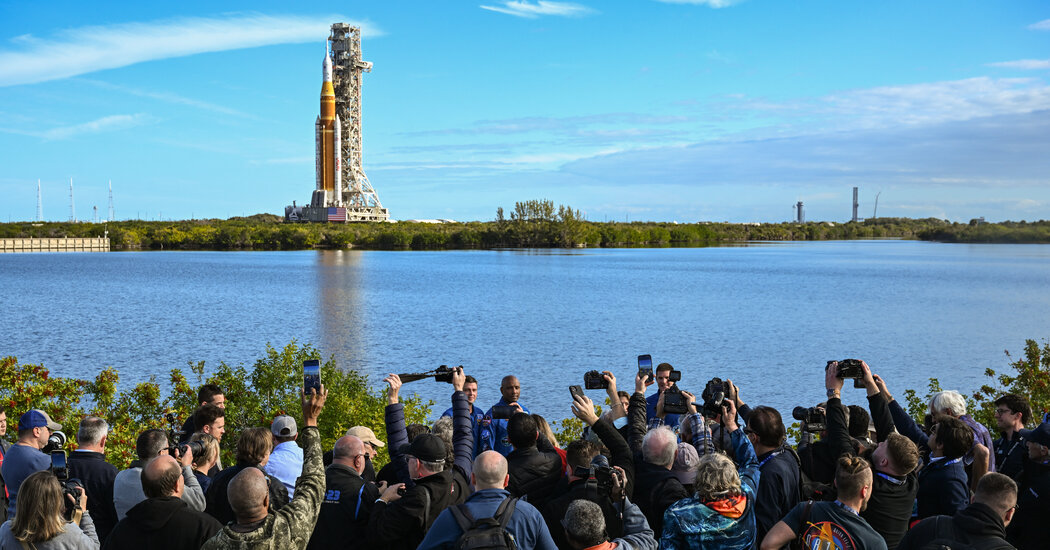
On Thursday evening, NASA successfully completed a countdown rehearsal for the Artemis II lunar mission, experiencing only a few minor glitches.
That was a significant improvement over the agency’s first attempt a few weeks ago, which was aborted due to leaks in hydrogen, the fuel used by the rocket.
“Proud of the @NASA team as this was a huge step toward America’s return to the lunar environment,” NASA Administrator Jared Isaacman wrote Friday morning on X. “We’re leaving.”
Unless a subtle showstopper emerges when reviewing the data, the near-flawless sample should pave the way for a launch attempt for Artemis II in a few weeks.
“We have no indication of anything that we’re concerned about,” John Honeycutt, chairman of the mission management team for Artemis II, said during a press conference Friday morning. “But we’re just getting started.”
Lori Glaze, acting associate administrator of NASA’s Mission Directorate for Exploration Systems Development, said the agency plans to conduct a thorough review of the data late next week to determine whether the mission is ready to fly.
If the mission is successful, NASA officials may announce a launch date. The agency is currently targeting March 6, Ms. Glaze said. “Right now, that’s the direction we’re going,” she said.
There are additional starting opportunities on March 7th, 8th, 9th and 11th. If Artemis II misses these, it will have to wait for the next possible launch dates in April.
The four-member crew – three NASA astronauts and one from the Canadian Space Agency – will quarantine on Thursday as a precautionary measure to ensure they stay healthy.
“The enthusiasm for Artemis II is really growing,” she said.
This launch will send the astronauts on a ten-day journey that will take them around the moon and return to Earth. The astronauts won’t land on the moon, but they will be the first to leave low Earth orbit since the end of NASA’s Apollo program more than 50 years ago.
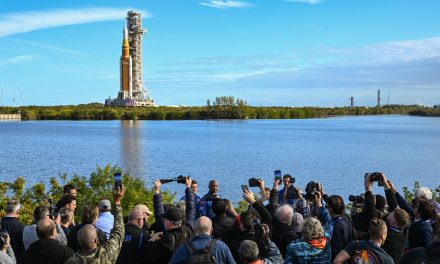
The two-day countdown test at NASA’s Kennedy Space Center in Florida involved filling the giant Space Launch System rocket’s tanks with millions of pounds of liquid hydrogen and liquid oxygen.
The SLS design is largely a remix of decades of technology from NASA’s space shuttles. The rocket on the launch pad contains leftover engines and other parts from the retired shuttles.
Like the shuttles, SLS has been plagued by hydrogen leaks at the launch pad.
Because hydrogen is the lightest element, it is efficient and provides the most energy per pound of any fuel. But hydrogen molecules, which are made up of pairs of hydrogen atoms, are also small and notoriously difficult to contain.
The first attempt resulted in significant hydrogen leaks at the interface between the rocket and the launch pad. The tanks were finally filled, but hours behind schedule.
But in the final part of the countdown, the hydrogen leak occurred again and the sample ended about five minutes before the countdown ended.
Technicians have now replaced the seals at the intersection.
On Thursday, hydrogen behaved well throughout the countdown, with concentrations near the compound at 1.6 percent or less, well below the 16 percent limit.
“Really no significant leakage,” said Charlie Blackwell-Thompson, the launch manager.
Minor problems included a problem with ground communications in the launch control center and a “voltage anomaly” in a battery measurement that briefly paused the countdown when there were 90 seconds left.
The countdown continued, counting down to 33 seconds and then stopping as planned. The countdown clock was then reset to 10 minutes as the systems reconnected.
This allowed NASA to practice resetting a launch attempt to fix a last-minute problem rather than aborting the attempt.
The reset, which involved filling the rocket’s fuel tanks with hydrogen and oxygen, was expected to take about an hour. “We did it in 57 minutes,” Ms. Blackwell-Thompson said.
The countdown then continued and ended again as planned – this time there were 29 seconds left.
It was a busy night in Florida. As the Artemis II rocket sat on the launch pad, a SpaceX Falcon 9 rocket blasted off from a nearby launch pad at Cape Canaveral Space Force Station, carrying a load of Starlink satellites into orbit.