









Investigators blame NASA and Boeing for Starliner failures
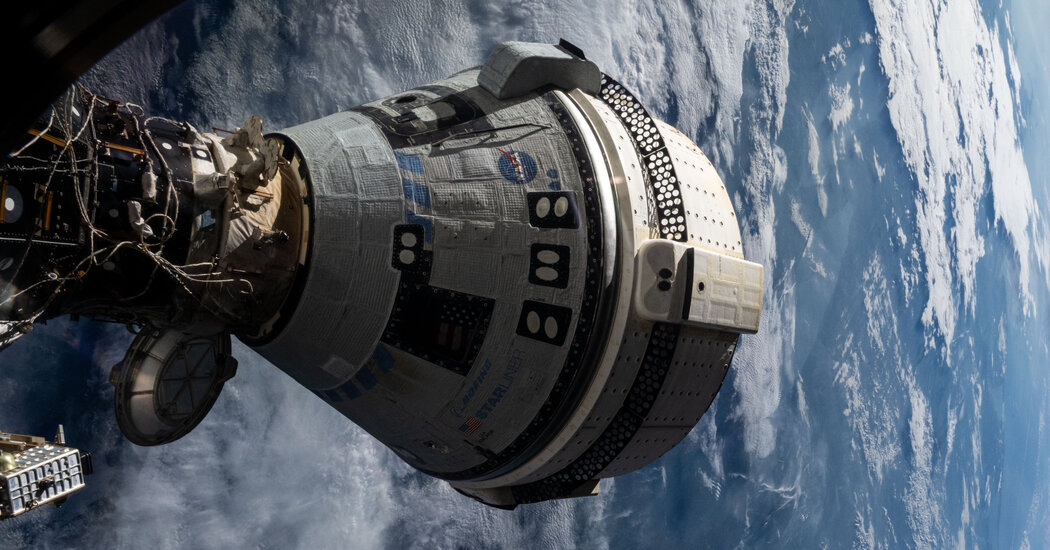
An investigation into the troubled flight of Boeing’s Starliner spacecraft to the International Space Station in 2024 has uncovered a series of technical and management failures by both NASA and the aerospace company.
Jared Isaacman, NASA’s administrator, said at a news conference Thursday that the problems pointed to flaws in the space agency’s culture that could endanger the lives of its astronauts.
As recommended in the report, NASA has classified the flight as a “Type A mishap,” the highest designation for a mission failure. The loss of the space shuttles Columbia and Challenger, in which the astronauts on board died, was also a Type A event.
After the Starliner failed, two astronauts, Suni Williams and Butch Wilmore, remained on the space station for nine months. Their stay was only supposed to last eight days, although it wouldn’t have been a surprise if this test flight had extended to a few weeks.
“We are trying to clarify the facts and assess the situation accordingly so that lessons can be learned,” Mr Isaacman said at the press conference announcing the results.
Mr Isaacman said the most worrisome deficiencies were not hardware failures but problems in “decision-making and leadership that, if left unchecked, could create a culture incompatible with human spaceflight.”
The greatest danger to the astronauts came when the Starliner’s engines failed as it approached the space station. Enough engines were restarted to allow the astronauts to dock successfully.
“Had different decisions been made at that moment, had the engines not been recovered or had the docking been unsuccessful, the outcome of this mission could have been very, very different,” Mr. Isaacman said.
While Boeing and NASA engineers tried to figure out what went wrong, Ms. Williams and Mr. Wilmore remained at the station for months. NASA ultimately decided that the Starliner would return empty, and the two astronauts ultimately returned to Earth in a SpaceX Crew Dragon spacecraft instead.
After the Space Shuttle was retired in 2011, NASA contracted with Boeing and SpaceX to transport NASA astronauts to and from the space station. SpaceX’s first mission of 2020 was successful and the Elon Musk-led company has since successfully launched twelve additional missions for NASA.
SpaceX’s success shows how an entrepreneurial approach can accelerate NASA’s progress at lower costs, but Boeing’s missteps show that this may be far from the case. NASA has used a similar route for the landers to be used on Artemis missions that will take astronauts to the lunar surface.
Deficiencies cited in investigators’ report include inadequate testing, continuing the flight when engineers did not fully understand previous engine malfunctions and inadequate oversight of Boeing by NASA.
Mr Isaacman said the engine problems were still not fully resolved. “We will not fly again, with or without a crew, until it is finished,” he said.
The investigators’ report also described dysfunction at both Boeing and NASA. “Disagreements over crew return options resulted in unprofessional behavior while the crew remained in orbit,” Isaacman said.
In a statement, Boeing said the company remains committed to Starliner.
“Boeing has made significant progress on corrective actions for technical challenges we encountered and has driven significant cultural changes across the team that directly align with the report’s findings,” the company said in a statement. “The NASA report will strengthen our ongoing efforts to strengthen our work.”
Starliner is just one example of faulty engineering in Boeing’s recent past. The company’s reputation was severely damaged by the fatal crashes of two 737 Max jetliners in 2018 and 2019.
In January 2024, a panel tore down another 737 Max, again raising concerns about the company’s quality and safety standards.
The International Space Station is scheduled to be decommissioned in 2030. In November, NASA and Boeing amended the Starliner contract, reducing the number of guaranteed flights from six to four.
However, Mr. Isaacman said NASA remains committed to using Starliner. Space agency officials said owning different spacecraft from different companies provides options in case problems arise.
“There will be other space stations, I guarantee it,” he said. “And they will require crew and cargo access to and from low Earth orbit. And I think the nation and the world will benefit from having multiple providers capable of doing that.”